
Cloud Migration
Dependency Intelligence: The Foundation of Every Successful Cloud Migration
Why understanding application dependencies is more important than understanding servers, and how dependency intelligence drives migration planning, security analysis, and transformation success.
Introduction
Most organizations believe cloud migration is primarily about moving servers, virtual machines, databases, and storage to the cloud.
In reality, migration success depends on something far more important: understanding how applications interact with each other.
A server can be migrated in hours. An application ecosystem can take months to understand.
After working on multiple enterprise migration programs, one lesson consistently emerged: migration challenges rarely originate from moving infrastructure. They originate from hidden application dependencies.
This is where Application Dependency Mapping (ADM) becomes critical.
What is Application Dependency Mapping?
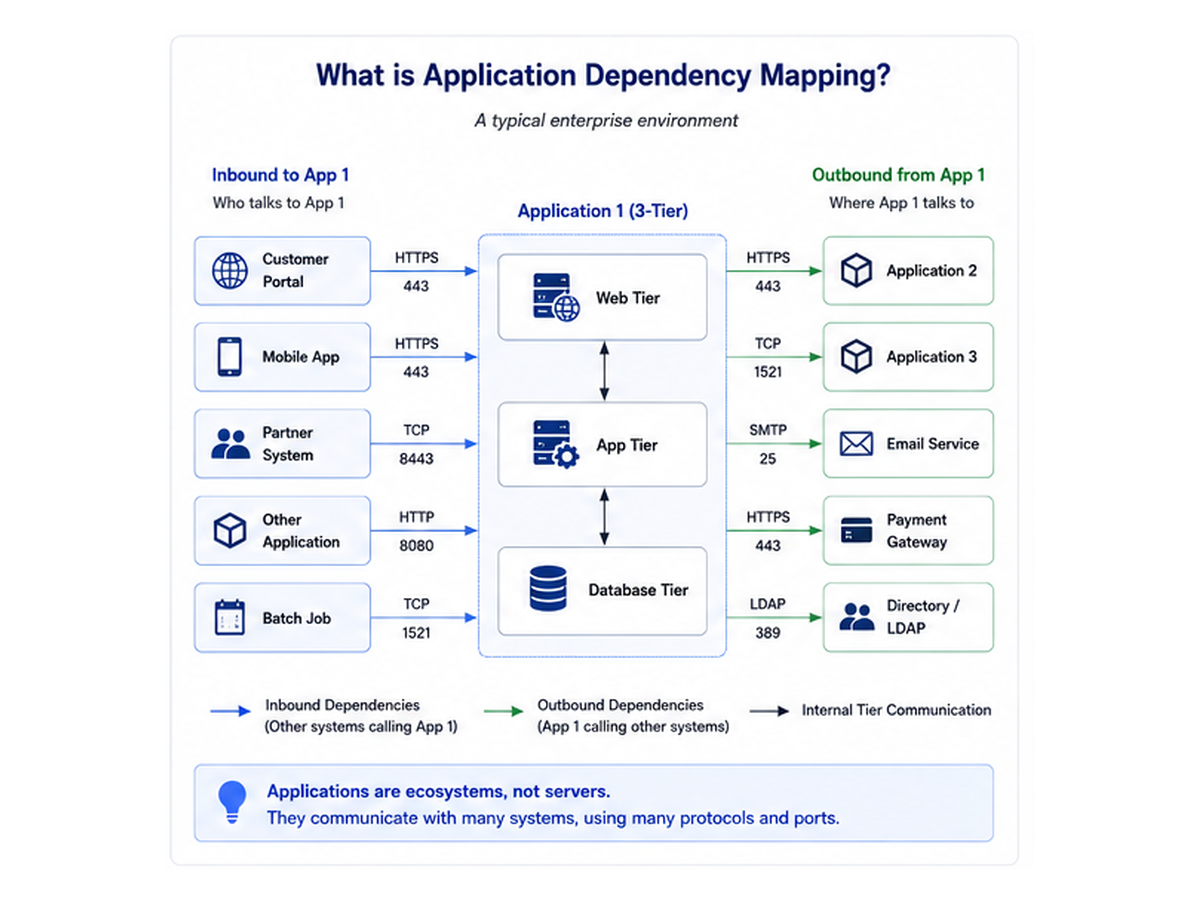
Application Dependency Mapping is the process of discovering and understanding relationships between applications, infrastructure components, databases, networks, security controls, and business services.
A typical enterprise application rarely operates in isolation.
A customer portal, for example, may depend on:
- Web servers
- Application servers
- Databases
- Authentication systems
- DNS services
- SMTP gateways
- Monitoring platforms
- Third-party APIs
Migrating only one component without understanding these relationships can result in outages, failed migrations, and unexpected business disruption.
ADM provides visibility into these dependencies before migration activities begin.
Why Dependency Mapping Matters
Many migration programs begin with infrastructure inventories.
Questions such as:
- How many servers do we have?
- What operating systems are deployed?
- What is CPU and memory utilization?
- What applications are installed?
These questions are important, but they do not answer the most critical question:
“What will break if this workload is moved?”
Dependency mapping helps answer that question.
It allows organizations to understand:
- Application-to-application communication
- Application-to-database relationships
- External integrations
- Shared services
- Business service dependencies
- Security and firewall requirements
Without this understanding, migration planning becomes guesswork.
When Should ADM Be Performed?
Application Dependency Mapping should begin during the Discovery and Assessment phase of a migration program.
This is often the earliest stage where organizations collect information about:
- Infrastructure inventories
- Application portfolios
- Network connectivity
- Security controls
- Business services
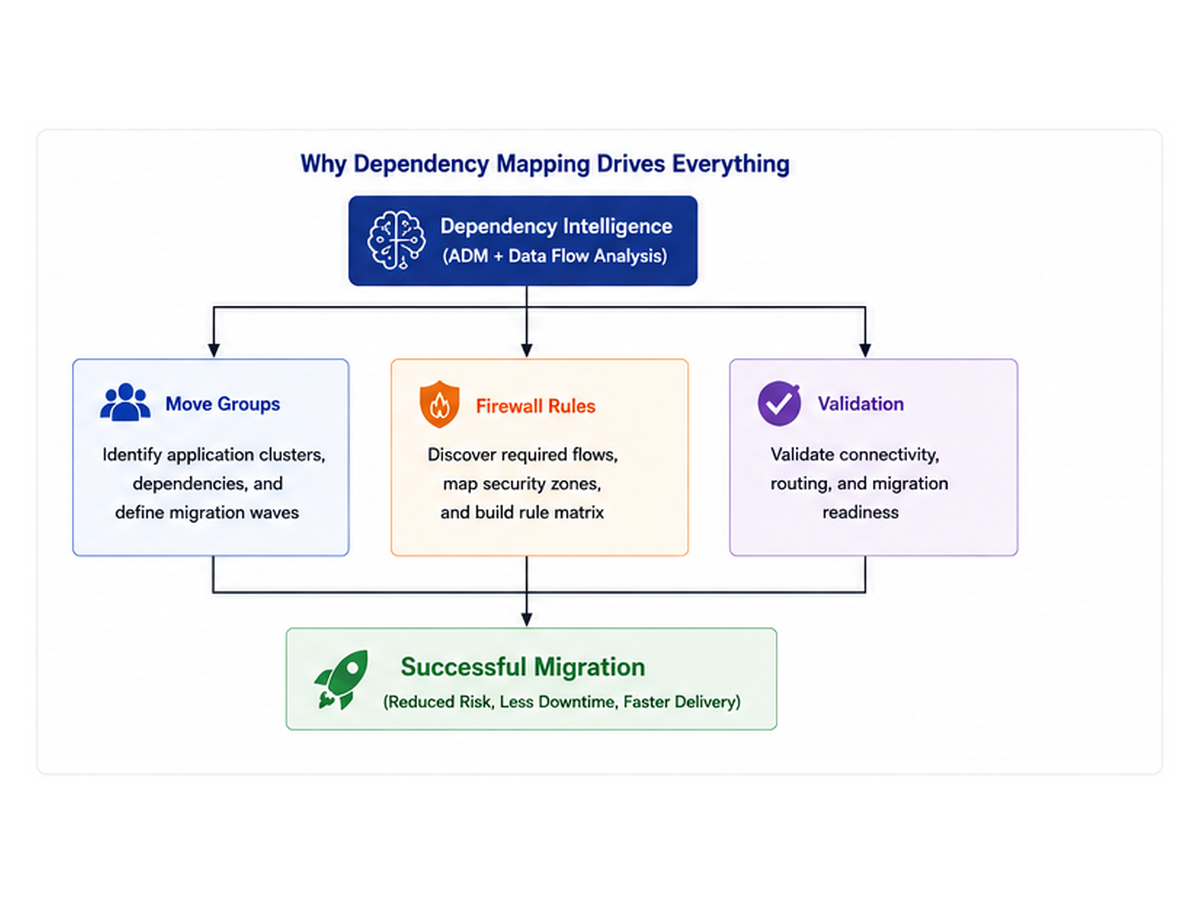
Performing ADM early provides a foundation for all downstream migration activities.
The output of dependency mapping directly influences:
- Migration strategy
- Migration wave planning
- Firewall analysis
- Landing zone design
- Validation planning
- Cutover sequencing
The earlier dependency intelligence is available, the lower the migration risk.
How ADM Works
Modern ADM solutions typically combine multiple information sources.
Examples include:
- CMDB platforms
- Network flow data
- Firewall logs
- DNS records
- Monitoring systems
- Application telemetry
- Cloud APIs
- Infrastructure inventories
The objective is to build a continuously evolving understanding of how applications interact within the enterprise.
Rather than generating static diagrams, modern ADM creates a living dependency model that reflects actual operational behavior.
Beyond Diagrams: Building a Dependency Graph
One of the biggest misconceptions about dependency mapping is that the final output is a Visio diagram.
In reality, dependency mapping is fundamentally a graph problem.
Applications become nodes.
Relationships become connections.
The enterprise becomes a dependency graph.
For example:
Customer Portal
→ Authentication Service
→ Product Database
→ Payment Gateway
→ Notification Service
→ Logging Platform
The value is not the diagram itself.
The value lies in understanding how changes in one component impact everything connected to it.
Common ADM Challenges
While dependency mapping provides significant value, it is rarely straightforward.
Incomplete Documentation
Many organizations rely on documentation that no longer reflects operational reality.
Systems evolve over time while architecture diagrams remain unchanged.
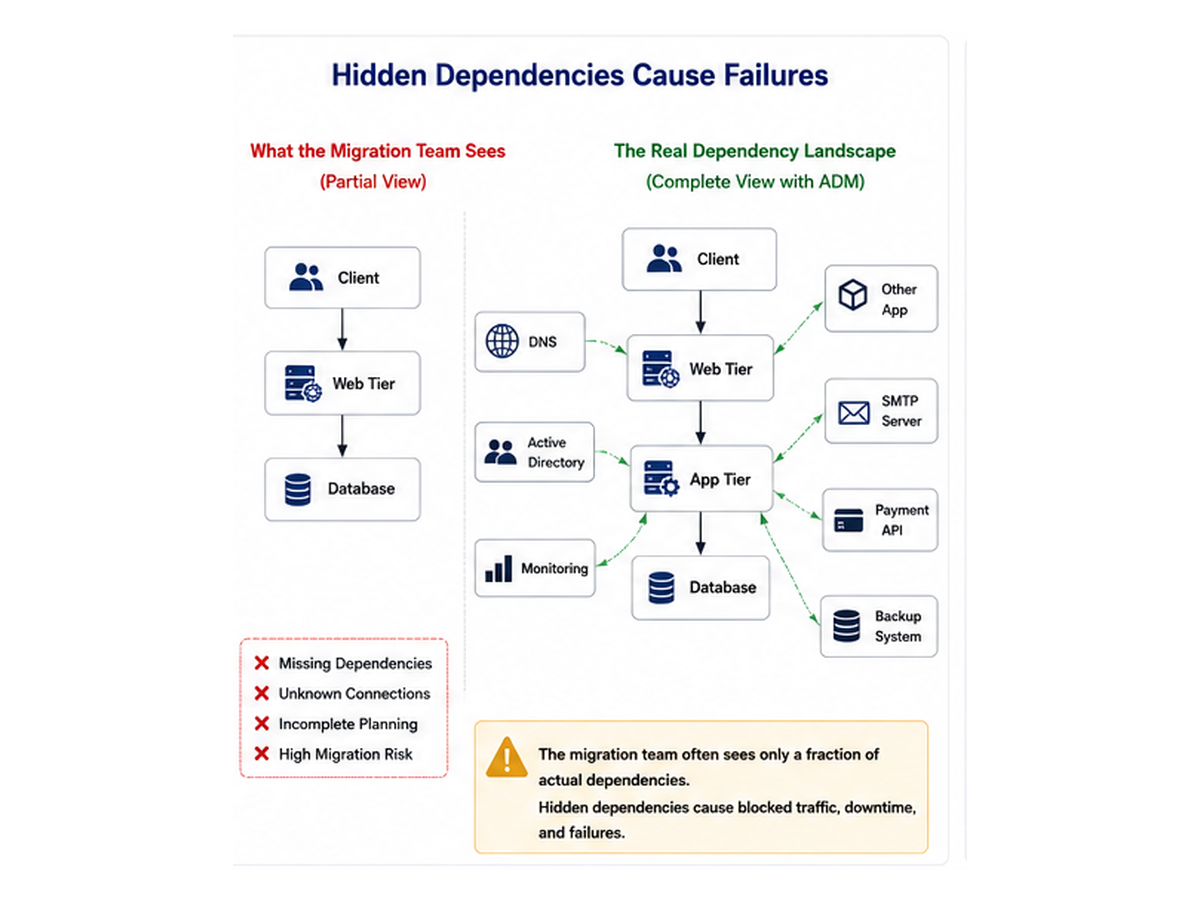
Hidden Dependencies
Applications frequently communicate with systems that application teams are unaware of.
Examples include:
- Legacy integrations
- Shared databases
- Hardcoded connections
- Third-party services
These dependencies often surface only during migration testing.
Dynamic Environments
Modern environments change continuously.
Applications are updated, new integrations are introduced, and workloads are moved.
Dependency maps must therefore remain current rather than becoming one-time project deliverables.
Data Overload
Many ADM tools can discover thousands of connections.
The challenge is not finding dependencies.
The challenge is identifying which dependencies matter.
Common Failure Patterns
Several recurring failure patterns appear across migration programs.
Treating Servers as Applications
Migration teams often plan migrations around infrastructure components rather than application services.
Applications rarely align neatly with server boundaries.
Relying Solely on CMDB Data
CMDB platforms provide valuable information but often represent intended architecture rather than observed behavior.
Operational telemetry frequently reveals additional dependencies.
Ignoring Shared Services
Services such as:
- Active Directory
- DNS
- Monitoring
- Backup systems
- Authentication services
are frequently overlooked during planning but can become critical migration blockers.
Static Dependency Analysis
Dependency mapping is often performed once and then forgotten.
As environments evolve, dependency information quickly becomes outdated.
Best Practices
Several practices consistently improve ADM outcomes.
Combine Multiple Data Sources
No single source provides a complete picture.
Effective dependency mapping combines:
- CMDB data
- Observed traffic
- Telemetry
- Infrastructure inventories
- Application team knowledge
Focus on Business Services
Applications should be mapped to business capabilities rather than infrastructure components alone.
This helps prioritize migration sequencing and risk analysis.
Continuously Update Dependencies
Dependency intelligence should be maintained throughout the migration lifecycle rather than treated as a one-time assessment activity.
Validate with Application Teams
Automated discovery is powerful but should be supplemented with business and application context from subject matter experts.
From Dependency Mapping to Dependency Intelligence
Traditionally, dependency mapping has been viewed as a migration project task.
A more valuable approach is to treat dependency information as an enterprise asset.
Dependency intelligence can support:
- Cloud migration
- Data center migration
- Mergers and acquisitions
- Security transformation
- Zero Trust initiatives
- Disaster recovery planning
- Application modernization
The same dependency graph can provide value long after a migration project is completed.
##Lessons Learned
In many migration programs, firewall issues are not caused by incorrect firewall configurations. They are caused by incomplete understanding of application communication patterns.
When application dependencies are not fully understood, firewall rule mapping becomes guesswork.
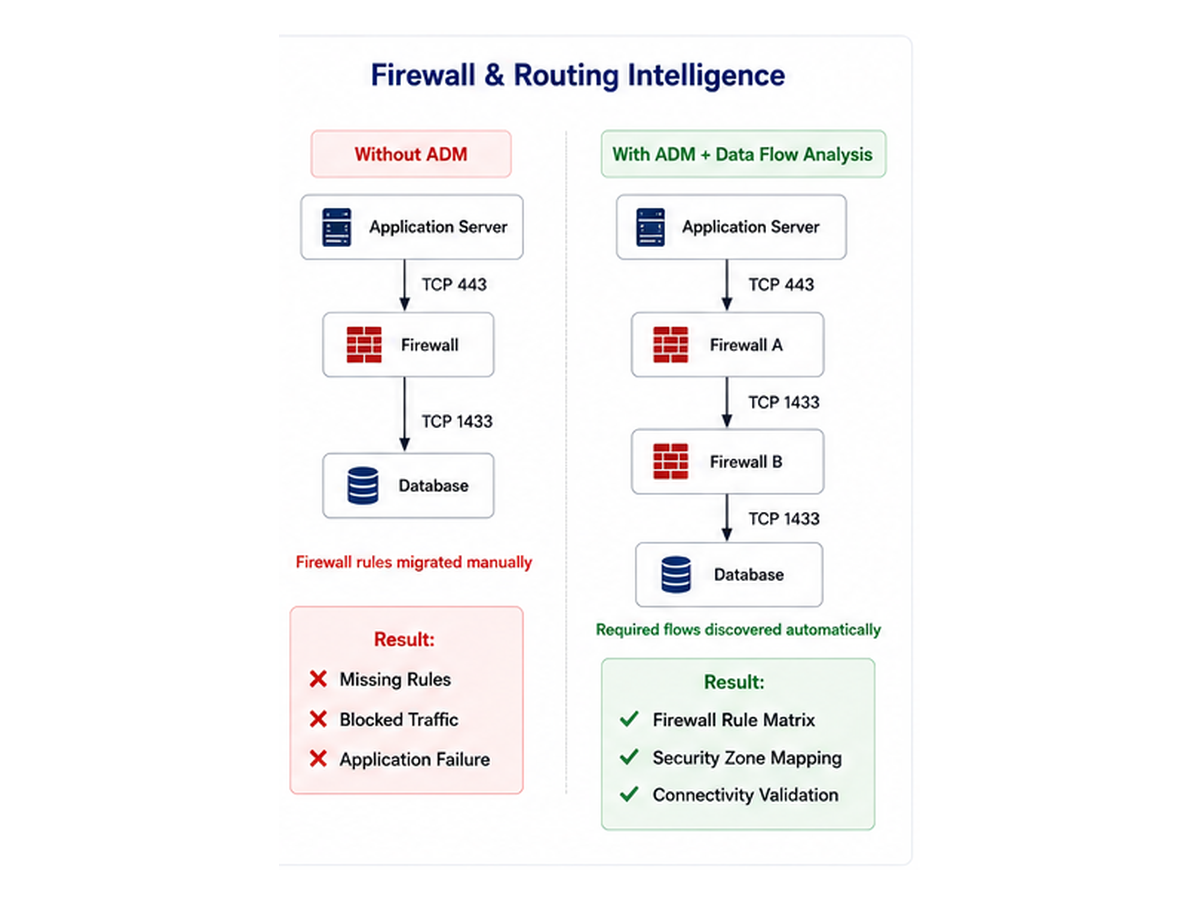
Similarly, routing and network integration decisions may introduce asymmetric traffic flows that were never present in the source environment.
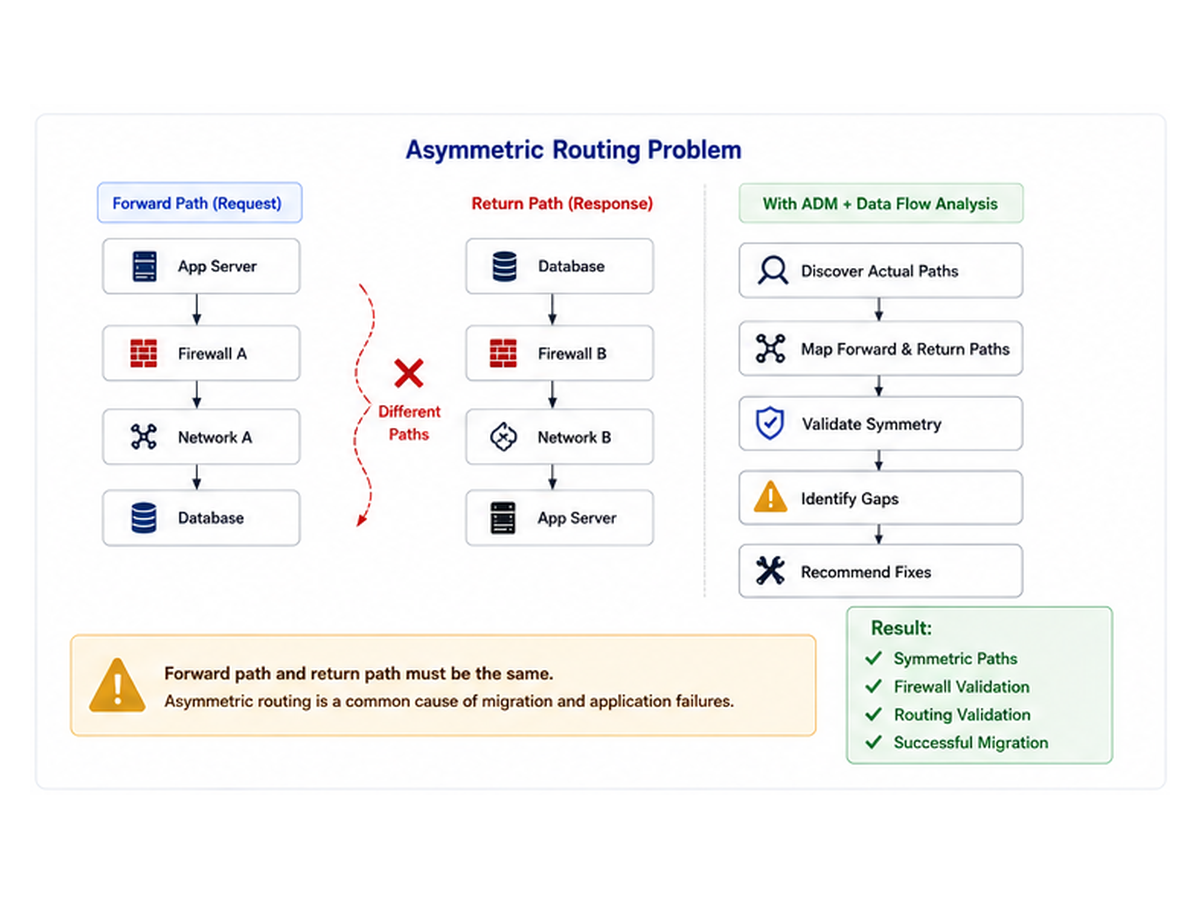
Combining Application Dependency Mapping with Application Data Flow Diagrams provides a more complete operational view of the application ecosystem. This allows migration teams to accurately design firewall policies, validate traffic paths, identify routing dependencies, and reduce cutover risk before workloads are migrated.
The Role of AI
AI does not magically discover application dependencies.
First, organizations must build a reliable dependency model.
Once that foundation exists, AI can reason across relationships to support:
- Migration wave recommendations
- Risk analysis
- Firewall policy reviews
- Security segmentation
- Architecture design
- Validation planning
The quality of AI recommendations ultimately depends on the quality of dependency intelligence beneath it.
Conclusion
Before cloud migration becomes an execution problem, it is a dependency understanding problem.
Organizations that understand application dependencies can migrate with confidence, reduce risk, and accelerate transformation programs.
Organizations that do not are simply moving uncertainty from one environment to another.
Dependency mapping is therefore not just a migration activity.
It is the foundation upon which migration intelligence is built.