
Cloud Migration
Cloud Migration at Machine Speed with Agentic AI
How Agentic AI, enterprise knowledge graphs, and unified data hubs can transform cloud migration planning from months of manual effort into an intelligent, automated workflow.
Introduction
Cloud migration remains one of the most complex transformation initiatives undertaken by enterprises. Despite advances in cloud platforms and migration tools, most migration programs still rely heavily on spreadsheets, workshops, manual assessments, and large consulting teams.
Infrastructure inventories, application dependencies, firewall policies, utilization metrics, CMDB records, and operational data are typically scattered across multiple systems. Gathering and correlating this information often consumes more time than the migration itself.
The emergence of Agentic AI introduces a new operating model. Instead of humans manually collecting and analyzing data, specialized AI agents can continuously gather, correlate, reason, and generate migration plans using a unified enterprise intelligence layer.
The result is a shift from migration projects measured in months to migration planning cycles measured in minutes.
The Traditional Migration Challenge
A typical migration program includes several major workstreams:
- Discovery and Assessment
- Application Dependency Mapping
- Migration Wave Planning
- Firewall Rule Analysis
- Architecture and Design
- Migration Execution
- Validation and Handover
Each workstream depends on information generated by previous phases, creating bottlenecks and delays.
In many enterprises, data is distributed across:
- VMware vCenter
- Public cloud platforms
- ServiceNow CMDB
- Device42
- Monitoring systems
- NetFlow platforms
- Firewall management tools
- DNS services
- Storage arrays
- ITSM platforms
As a result, migration planning becomes a lengthy process of collecting, validating, and reconciling data from multiple sources.
A New Approach: Agentic AI for Cloud Migration
Imagine every migration workstream having a specialized AI agent.
Rather than moving spreadsheets between teams, agents collaborate through a shared enterprise knowledge layer.
Each agent performs a specific function while continuously exchanging information with other agents.
Migration becomes an intelligence workflow rather than a documentation workflow.
The Unified Enterprise Data Hub
At the center of the platform sits a Unified Enterprise Data Hub.
The purpose of the data hub is to continuously ingest, normalize, and correlate information from enterprise systems.
Data can be gathered through:
- APIs
- MCP-based connectors
- Event streams
- Data pipelines
- File imports
The result is a normalized enterprise model representing:
- Infrastructure assets
- Applications
- Networks
- Security relationships
- Business services
- Operational telemetry
This unified model becomes the foundation for AI-driven migration planning.
Building an Enterprise Knowledge Graph
Raw data alone is not enough.
The platform must understand relationships.
For example:
Application A
→ Runs on VM B
→ Communicates with Database C
→ Protected by Firewall D
→ Supports Business Service E
→ Owned by Team F
By connecting these relationships, the platform creates an enterprise knowledge graph.
This allows AI agents to reason about dependencies, risks, migration sequencing, and operational impacts.
Agentic AI Workflow for Cloud Migration
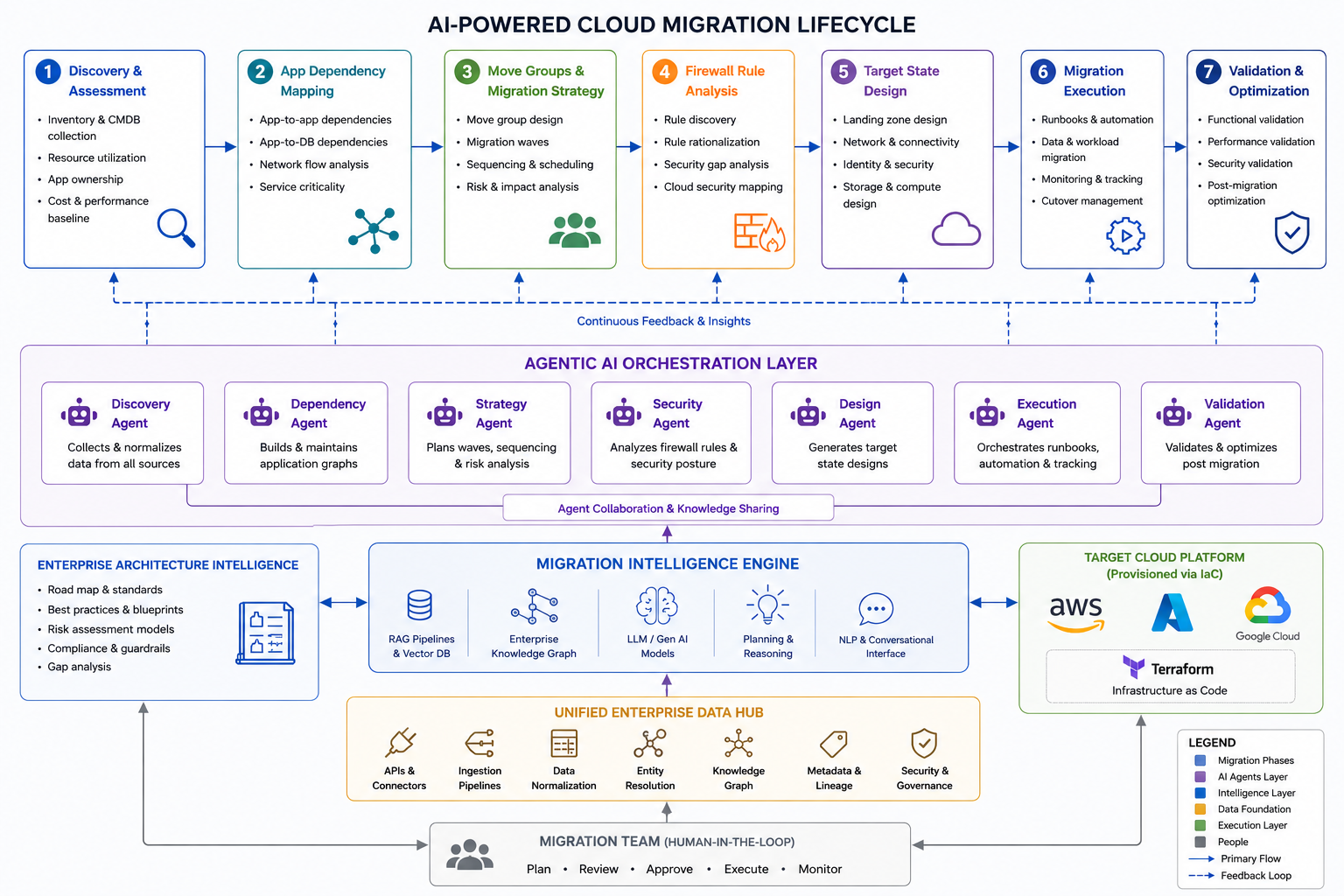
Discovery and Assessment Agent
The Discovery Agent continuously gathers infrastructure information from enterprise systems.
Outputs include:
- Server inventory
- Virtual machine inventory
- Operating systems
- Resource utilization
- Application ownership
- Business mappings
What traditionally takes weeks can become an automated process.
Application Dependency Mapping Agent
Dependency mapping is one of the most critical migration activities.
Using observed traffic patterns, telemetry, CMDB relationships, and network flows, the Dependency Mapping Agent builds a dynamic application graph.
The agent identifies:
- Application dependencies
- Database relationships
- East-west traffic
- Shared services
- Critical communication paths
Instead of static diagrams, organizations gain continuously updated dependency maps.
Migration Strategy Agent
Once dependencies are known, AI can automatically generate migration strategies.
The agent evaluates:
- Business criticality
- Technical dependencies
- Maintenance windows
- Operational constraints
- Risk profiles
Outputs include:
- Migration waves
- Migration sequencing
- Rollback considerations
- Risk assessments
Security and Firewall Analysis Agent
Firewall analysis is often one of the most labor-intensive phases of migration.
The Security Agent analyzes:
- Existing firewall policies
- Traffic flows
- Security zones
- Cloud-native security models
Outputs include:
- Firewall migration matrices
- Rule optimization opportunities
- Security policy recommendations
- Microsegmentation candidates
Architecture and Design Agent
Using information generated by previous agents, the Design Agent creates target-state architectures.
This includes:
- Landing zones
- Network architecture
- Security architecture
- High availability designs
- Disaster recovery designs
The output is not merely documentation. It becomes an executable target-state blueprint.
Migration Execution Agent
Execution agents orchestrate migration activities across migration waves.
Examples include:
- Migration tool configuration
- Runbook generation
- Change sequencing
- Validation orchestration
- Status tracking
The platform maintains visibility into migration progress and outcomes.
Validation Agent
After migration, validation agents verify:
- Application availability
- Endpoint reachability
- Service health
- Performance baselines
- Security posture
Validation becomes continuous and automated.
Where Generative AI Fits
A common misconception is that Generative AI replaces traditional automation.
In reality, both play different roles.
Deterministic Systems Handle
- Data collection
- API integrations
- Workflow execution
- Rule processing
- Calculations
- Dependency graph creation
Generative AI Handles
- Reasoning
- Recommendations
- Design generation
- Report generation
- Decision support
- Natural language interaction
The combination provides both reliability and intelligence.
From Months to Minutes
Traditional migration planning often follows this timeline:
- Discovery: Weeks
- Dependency Mapping: Weeks
- Firewall Analysis: Weeks
- Wave Planning: Weeks
- Architecture Design: Days or Weeks
- Reporting: Days
With a Unified Enterprise Data Hub and Agentic AI platform:
- Data collection becomes continuous
- Dependency maps remain current
- Migration plans update automatically
- Architectures can be generated on demand
- Reports become real-time
The bottleneck shifts from data gathering to decision making.
Beyond Cloud Migration
The same intelligence platform can be extended to support:
- Data center migrations
- Mergers and acquisitions
- Cloud modernization
- Security transformation
- Network transformation
- Application rationalization
- FinOps optimization
Cloud migration becomes the first use case of a much larger enterprise intelligence platform.
Conclusion
The next generation of cloud migration platforms will not be defined solely by migration tools.
They will be defined by their ability to understand enterprise environments, reason across complex dependencies, and automate decision-making at scale.
By combining a Unified Enterprise Data Hub, enterprise knowledge graphs, deterministic automation, and Agentic AI, organizations can transform migration planning from a months-long consulting exercise into a near real-time intelligence workflow.
The future of cloud migration is not simply automation.
It is autonomous enterprise transformation.