
Cognitive Stacking: A Theory of Efficient Intelligence Consumption
Executive Summary
The first generation of Artificial Intelligence focused on maximizing intelligence.
From 2023 through 2026, the dominant assumption across the industry was straightforward: larger models, more parameters, larger context windows, and greater compute capacity would continuously improve cognitive capability.
This approach produced remarkable advances in reasoning, coding, content generation, and scientific discovery. However, it also introduced significant challenges. Model training costs increased exponentially. Inference workloads expanded rapidly. Data centers consumed increasing amounts of power and water. Enterprises began experiencing escalating operational costs as autonomous agents generated thousands of model interactions for routine business processes.
The next phase of AI may not be defined by creating the largest intelligence systems. Instead, it may be defined by using intelligence efficiently.
Human intelligence evolved under strict energy constraints. The brain does not apply maximum cognitive effort to every task. It dynamically allocates cognitive resources based on complexity, uncertainty, and importance.
Future AI systems may follow the same principle.
This paper introduces Cognitive Stacking, an architectural framework in which intelligence is consumed in layers, escalating to increasingly sophisticated reasoning only when required. Rather than treating every task as a frontier-model problem, Cognitive Stacking allocates intelligence proportionally to the complexity of the problem being solved.
The result is a more scalable, economical, and sustainable model for the Intelligence Age.
The Intelligence Consumption Problem
Modern AI systems often route every task through the same reasoning engine regardless of complexity.
A simple scheduling request, a routine operational question, and a complex scientific problem may all consume similar categories of cognitive infrastructure.
This approach creates several challenges:
- Rising inference costs
- Increased power consumption
- Higher latency
- Excessive infrastructure requirements
- Reduced predictability of enterprise operating costs
The challenge is not a shortage of intelligence.
The challenge is inefficient intelligence allocation.
The future of AI may therefore be shaped by a new optimization objective:
Deliver the required outcome using the minimum necessary intelligence.
Human Cognition as a Model
Human cognition operates through multiple layers.
Most daily activities require very little conscious reasoning. Only a small percentage of decisions require deep analysis, strategic thinking, or exploration of unknown concepts.
Humans do not apply maximum intelligence to every task.
They apply sufficient intelligence.
This distinction is critical.
A person reading a street sign, selecting a meal, designing a network architecture, and developing a new scientific theory is not using the same cognitive resources in each situation.
Future AI systems may increasingly adopt a similar model.
The Cognitive Stack
Cognitive Stacking organizes intelligence into progressively more capable layers.
Each layer handles tasks appropriate to its complexity. Escalation occurs only when lower layers cannot achieve the required outcome.
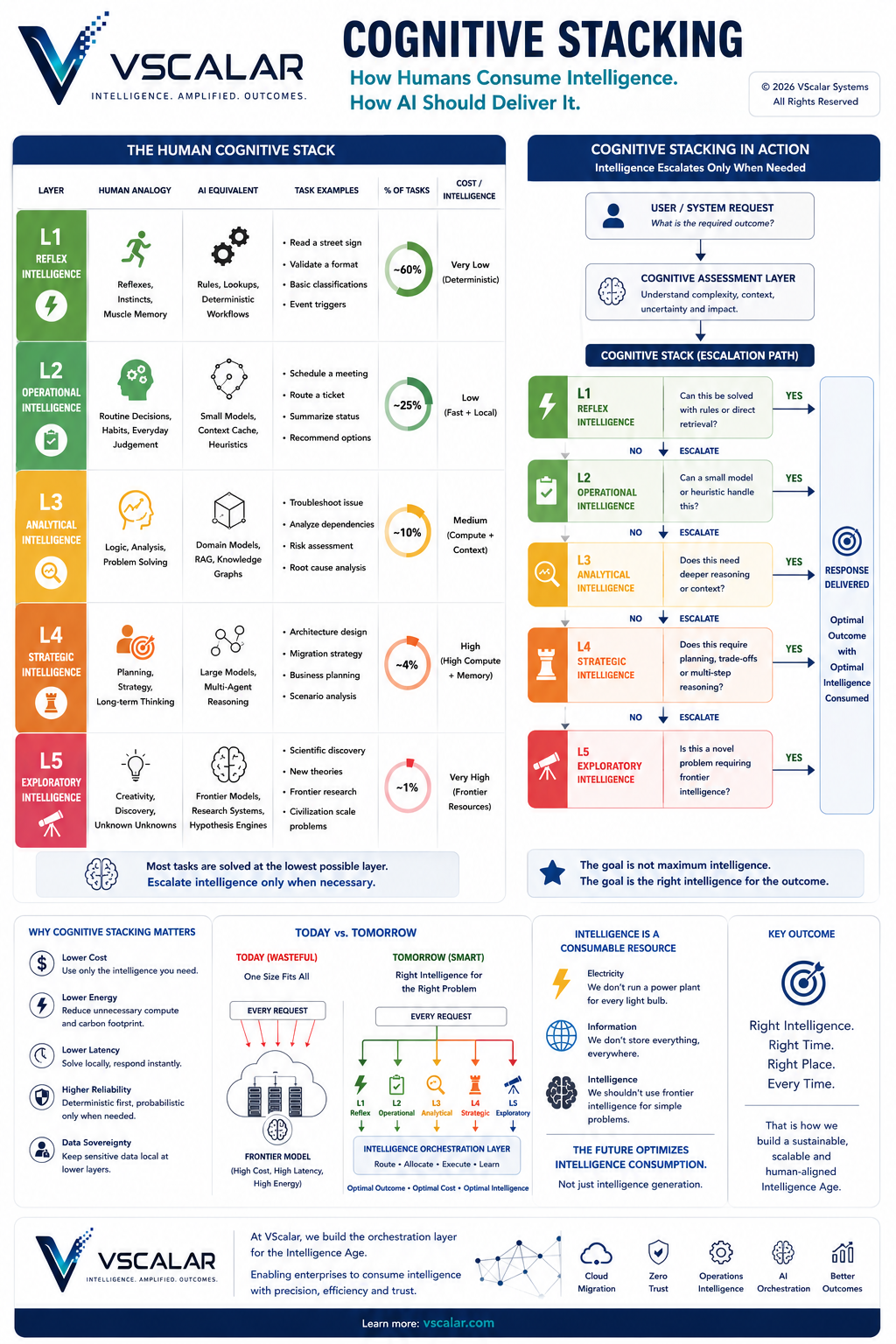
Layer 1: Reflex Intelligence
Reflex Intelligence handles highly predictable and deterministic activities.
Examples include:
- Rules-based automation
- Workflow execution
- Data lookups
- Event processing
- Basic classifications
Most enterprise transactions can be resolved at this layer without invoking generative AI.
Characteristics:
- Lowest cost
- Lowest latency
- Highest predictability
- Deterministic outcomes
Layer 2: Operational Intelligence
Operational Intelligence supports routine decision-making and everyday business processes.
Examples include:
- Ticket routing
- Status reporting
- Meeting scheduling
- Routine customer interactions
- Standard recommendations
These tasks typically require lightweight reasoning and contextual awareness but do not require frontier-level intelligence.
Characteristics:
- Small language models
- Local context awareness
- Low operational cost
- Fast response times
Layer 3: Analytical Intelligence
Analytical Intelligence is responsible for problem-solving and domain-specific reasoning.
Examples include:
- Infrastructure troubleshooting
- Dependency analysis
- Security investigations
- Capacity planning
- Risk assessments
This layer combines reasoning with contextual knowledge and often integrates structured enterprise data.
Characteristics:
- Domain specialization
- Context-driven reasoning
- Moderate computational cost
- High business value
Layer 4: Strategic Intelligence
Strategic Intelligence focuses on long-term planning and complex organizational decisions.
Examples include:
- Enterprise transformation
- Cloud migration strategy
- Mergers and acquisitions
- Regulatory planning
- Large-scale architecture design
These tasks require broader reasoning, scenario evaluation, and cross-domain understanding.
Characteristics:
- Long-horizon thinking
- Multi-domain reasoning
- Higher computational requirements
- Significant organizational impact
Layer 5: Exploratory Intelligence
Exploratory Intelligence addresses unknown problems where solutions may not yet exist.
Examples include:
- Scientific discovery
- Advanced research
- New mathematical frameworks
- Frontier AI development
- Civilization-scale planning
This layer represents the highest form of cognitive consumption and is where frontier models provide the greatest value.
Characteristics:
- Open-ended reasoning
- High uncertainty
- Maximum cognitive expenditure
- Creation of new knowledge
The Principle of Cognitive Escalation
The Cognitive Stack operates according to a simple principle:
Intelligence should only be escalated when lower cognitive layers cannot achieve the required outcome.
This principle mirrors how biological intelligence functions.
Most problems are resolved using minimal cognitive effort.
Only a small percentage require strategic or exploratory reasoning.
As AI systems mature, intelligence allocation may become more important than raw intelligence generation.
Context Becomes More Valuable Than Scale
A large model without context is often less effective than a smaller model operating with accurate, real-time information.
As intelligence systems become increasingly integrated into enterprises and daily life, context will become a critical differentiator.
Future AI systems will rely heavily on:
- Organizational knowledge
- Personal memory
- Historical interactions
- Real-time telemetry
- Domain-specific information
The quality of context may ultimately become more important than the size of the model itself.
Neuro-Symbolic Intelligence
Pure neural systems excel at language, pattern recognition, and probabilistic reasoning.
However, many real-world domains require deterministic outcomes.
Healthcare, finance, infrastructure, engineering, and government systems cannot rely solely on statistical probability.
Future architectures are likely to combine:
- Neural reasoning
- Knowledge graphs
- Rules engines
- Symbolic logic
- Deterministic execution frameworks
In this model, language models act as translators between human intent and machine execution, while deterministic systems perform validation and execution.
The result is greater reliability, transparency, and auditability.
The Rise of Intelligence Orchestration
The future of AI may not be defined by a single model.
It may be defined by systems that coordinate multiple forms of intelligence.
A modern intelligence platform may include:
- Rules engines
- Knowledge graphs
- Small language models
- Domain-specific agents
- Frontier reasoning systems
The role of orchestration is to determine which cognitive resource should be used for a specific task.
This transforms intelligence from a monolithic capability into a distributed utility.
Intelligence Efficiency
Throughout the Industrial Age, societies optimized energy consumption.
During the Information Age, organizations optimized information processing.
The Intelligence Age may optimize intelligence consumption.
Future systems may be measured not only by how intelligent they are, but by how efficiently they use intelligence.
Possible metrics include:
- Intelligence per watt
- Intelligence per dollar
- Intelligence per second
- Intelligence per decision
The most successful systems may not be those that generate the greatest amount of intelligence.
They may be those that achieve desired outcomes using the least amount of cognitive expenditure.
Conclusion
The first generation of AI focused on maximizing intelligence through scale.
The next generation may focus on allocating intelligence efficiently.
Cognitive Stacking provides a framework for understanding how intelligence can be consumed, escalated, and orchestrated according to the complexity of a problem.
As intelligence becomes an essential utility of modern society, efficiency may become as important as capability.
The future of AI may not belong to systems that think the most.
It may belong to systems that know when thinking is unnecessary.